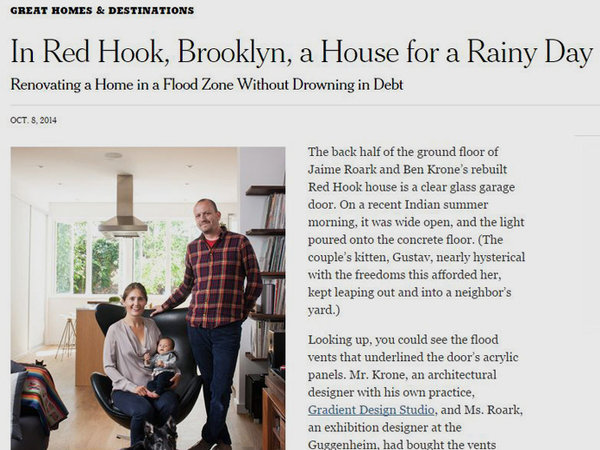
Gradient Design Studio was founded by Ben Krone in Brooklyn, New York. Originally conceived as a design collective exploring the intersections of graphic art and architecture, Gradient has established itself as a full service architecture and design firm specializing in cost effective means for producing high design through the use of computer-aided, precision manufacturing processes. After graduating first in his class from Columbia University's Graduate school of Architecture, Ben practiced for seven years with the architecture firm SHoP Architects in New York City where he held a lead role on a number of projects including the Virgin Atlantic First Class Lounge in JFK, Columbia University’s Dodge Hall renovation, a private residence for Roo Rogers and three residential developments in New York City ranging in scale from 15,000 to 30,000 square feet. Outside of his work with SHoP, Ben has designed and constructed a range of projects and exhibitions, including a number of high end private residences to the inclusion of a large scale art piece for Smithsonian's Cooper Hewitt National Design Museum. Ben's work has been featured in Surface Magazine, Compasses Journal (Europe), Metropolis, Architecture, Architectural Record, Interior Design magazine and on HGTV.

The Cho residence at 79 Laight street is located within a historic landmarked sugar warehouse in New York city’s Tribeca neighborhood. The modern interior plays of the dichotomy between old and new through the use of subtle curvatures in the surfaces that peal away to reveal warm materials and existing infrastructure behind. Fully integrated custom cabinetry hold a variety of programmatic elements including informal eating areas, several work stations, a wine bar, a library and a tv and entertainment area. The surfaces are made of thermoformed polished Corian over walnut infill. A forming mold for the surfaces are CNC routed MDF translated from digital files.

Scheduled construction February 2009

officeliving roomentryfloor detaillower planupper planelevationdoor detail

After working on an initial design in 2001 with Valerio Dewalt Train architects, Gradient Design Studio further defined this flexible Tribeca loft space with a new lighting, Graphic, and furniture scheme. Large-scale graphics, in collaboration with photographer Susan Fan, and visual artist Leah Raintree, are integrated to tie the warmth of the wood floors and trim with the sleek texture of the sheet metal space dividers. The concept was to bring the occupants closer to the array of surfaces defining the space. All of the furniture was designed specifically to rest directly on the floor, in order to break down the barriers between entertainment areas and play space for the young child.

Completed initially Summer 2001, renovation Winter 2005

livingliving 2officekitchencolumn detailfloor detail
drawingsdrawings 2fabrication 2fabricationpartsinstall

Located between 30th and 31st street on Madison Ave in NYC. The twelve story 21,000 square foot residential development integrates the existing brick infrastructure with a modern insertion. Prefabricated steel framed window boxes are projected out side of the existing building envelopes creating a full-length continuous sitting sill within. The two upper Penthouse spaces are made up of cantilevered steel and glass-stacked boxes with traversing spandrels clad in a prefabricated zinc façade system. The spaces within maximized light penetration from the East and West facades through the use of skylights on a stepped floor plate and windows that project beyond the building envelope. The finishes within contrast warm walnut wood floors and details with sleeker white lacquer and stone. Designed with SHoP Architects.

Completed February 2008

www.m127building.com

night shotph additionfacade 3facade 1facade 28th floor detailph decklobbylobby 2bedroom
bathph stairph stair 2facade drawingplan phplanzinc installwindow boxzinc fab

This 15,00 square foot residential development designed in collaboration with SHoP Architects is a gut rehab of an existing seven story china town residential development in the historic tenement district of new York City. Through the subtle use of natural materials and refurbished antique fixtures, the new storefront and rehabilitated façade are a contemporary interpretation of the historic nature of its context. Weathering steel is used to frame the original detailed cast iron structure. Two angled plate steel boxes mark the two distinct residential and retail entrances. Wired glass transom windows above set a rhythm for the custom steel and glass storefront while transitioning the upper residences from the retail space below. The interior continues the language of mixing warm natural materials with modern finishes.

Scheduled completion February 2009

store front 1store front 2store front 3

The objective of this space was to create a flexible, small white box that is defined enough to accommodate a young child, but is capable of expanding in a way to appear large and open. Two primary walls, which separate the bedrooms, slide open to reveal the entire floor area. Floor to ceiling cabinetry covers the two primary walls and is integrated with the required programmatic elements, from a hidden office, to closets and bicycle storage.

Completed Spring 2006

bedroom 1cabinet 1kitchenliving 1planrendering 2rendering 1

This developer office space required openness, flexibility and storage. At its largest, a desk defines the width of a full-size set of architectural drawings; at its smallest, the width of a CD. The custom shelving system's surfaces are defined by these two; everything in between becomes flexible storage. The entire system is built from CNC-cut plywood parts, individually numbered and assembled in an afternoon, with a large-scale graphic on SAV wallpaper serving as background.

Completed Winter 06

overalldetail 2detail 1shelf modelshelf model 2

In design

The industrial loft conversion combines two penthouse units into a single flexible living and workspace for an artist. The concept is to create highly flexible programmatic spaces that can be modified based on their use. The project is currently in design and is scheduled to begin construction winter 2009.

Conceptual thesis on woven textures as structural systems is first defined through an understanding of warp and weft relationships in various fabrics. Each system is understood for both its material and structural properties, as defined by the frequency, and layering techniques of the individual threads. Patterns are understood solely on the basis of surfacing characteristics and further developed into structural and panelization systems to create a range of enclosure types. The resulting technique generates an inherently flexible design system where pattern, texture, structure and enclosure are entirely integrated. The array of results is limitless. The project shows examples of three woven enclosure systems developed from weaving technique to final enclosure system.

Research Spring 2004

entryinteriorassembly 1diagram 3configuration 1configuration 3configuration 2plan detail
plan detail 1plan detail 2configurationfiguresmodelprocessdegree surfaceweaving

A school for the highline in New York City juxtaposes 'centrality' with experiential learning. By dismantling the barriers between educational and public spaces, the school repositions what has become a traditional, centralized institutional orientation to exist under the most flexible of circumstances. The repositioning facilitates direct interactions between students, working people, and members of the surrounding neighborhood. The school intervenes directly in the public realm. It draws upon a planned expansion of the abandoned elevated rail line slated to be converted to a public park. The public and private spaces mediate the existing structure and take advantage of the park space above.

Research November 2002

exteriorhighlineint classroomdiagrammodel 1model 2diagram 2plan cut

A series of space dividers and wall panels are digitally designed and manufactured. Based on an array of surfacing techniques, three dimensional computer files generate cutting and tooling paths for a CNC router. The textured panels have been installed as both ceiling and panelized wall systems in lobbies, offices and studios.

Ongoing

birds finalbird final 1bird detailbird prototypebird modelmetal screenripple modelripple 1

Project To Surface is a dynamic collaboration between five visual artists and an architect in rendering the artists concepts into three-dimensional form through the use of design fabrication tools and techniques. An important element of Project to Surface is the partnership of the artists vision with the architects hand and sense of spatial theory. This process begins as a simple dialogue but then explodes into something more complex and unexpected, morphing into a series of individual narratives. Together, these narratives document the experience of this exploratory collaboration. In applying advanced design and fabrication tools to project the artists visual concepts into physical objects, Project to Surface also seeks to explore the frontier of creative possibilities as well as the balance of intersecting art and architecture.

Open May 2007 - August 2007

www.projecttosurface.com

kh finalL final sidekaws finalM finaldd model 3gallery 1gallery 2kh final detail 3L final detailkh final detailkh final detail 2L final 1L final detail 2kh sketch 2kh model 3kh model 2
L model 1L model 2kh model 1kaws model 4kaws model 1kaws model 2kaws model 3dd model 2dd model 1kh prototype 1kh prototype 2L routerM prototypeM detailkh sketch 1kh sketch 3

The 'shift exhibition' design for Dreamsomuch art collective places 5 custom Japanese bicycles on display for both the Brooklyn, New York and Tokyo openings. Each bike is set at alternating heights such that they all revel themselves upon entering the space. Light boxes below each bike 'up light' both the customized details and act as a ballast for placing the hanging bike in tension between the ceiling and the floor.

Completed December 2004

12345

The Bloom Field Corian piece, designed in collaboration with visual artist Leah Raintree, was selected for a four-month exhibition at Smithsonian’s Cooper Hewitt National Design Museum. The Exhibition is a retrospective of design in the Rococo era as well as examples of how it continues to influence design today. The piece exemplifies how digital design and manufacturing processes are being utilized to create objects which are influenced by Rococo forms and lines. The Exhibit was curated by Ellen Lupton, Gail Davidson, and Sarah Coffin and was on display during the summer of 2008.

Piece completed May 2007, exhibition July 2008

rococo.cooperhewitt.org

L final sideL final detail 2L final 1L final detailL model 1L model 2L router

Digital/ Manual

The lecture Digital/ Manual was specially written for the prestigious ‘Festarch’ international architecture and design conference in Sardinia Italy. The lecture discussed the reality of designing in an environment where methods of construction have not caught up to advancements in sophisticated digital design techniques. The talk then presents through the lens of several of Gradients own built projects, different methods for translating complex designs into a language that the common carpenter and contractor can understand and implement. The lecture was presented in July of 2008 in Sardinia Italy.

www.festarch.it

Festarch

This lecture was presented to the Graduate School of Architecture and Design in the Fall of 2005. Lecture notes coming soon.

This lecture was presented to the Graduate School of Architecture and Design in the Spring of 2004. Lecture notes coming soon.

This lecture will be presented at the Talk 20 lecture series sponsored by Harvard Graduate School of Design December 4th 2008.

Design Issue 2007. Higher Planes

Surface Magazine

Designer of Bloom Field for Cooper Hewitt National Design Museum

Rococo the Continuing Curve

Hybrid Housing

Archiversiade 2003

February 2003. Transcendent in Tribeca

Architecture Digest 1Architecture Digest 2

June 2001. Valerio Dewalt Train Offices

Architectural Record 1Architectural Record 2

Design Issue 2007. Higher Planes

Architects Newspaper

Vol 60. Exhibition View Project to Surface

Interior World Magazine 2Interior World Magazine 2

September 2004. Man of Steel

Interior Design

Gradient Design Studio
181 N. 11th Street #406
Brooklyn, NY 11211

917 656 5135 telephone
917 720 9987 fax

download resume